BRENDEN CAVAZOS
Product · Excalibur
How Excalibur's Decision Trees Were Designed
An AI wins-and-corrections assistant built on a persona-mapping and decision-tree design process -- stakeholder research, workflow automation, and rule-based conversation design -- that replaced a manual, siloed reporting process with a single assistant that answers the same question differently depending on who's asking.
600+ hrs
annual manual burden identified
300 hrs
annual hours saved by automation
$22,500
annual direct savings
4
stakeholder personas mapped into decision trees
Design Process, at a Glance
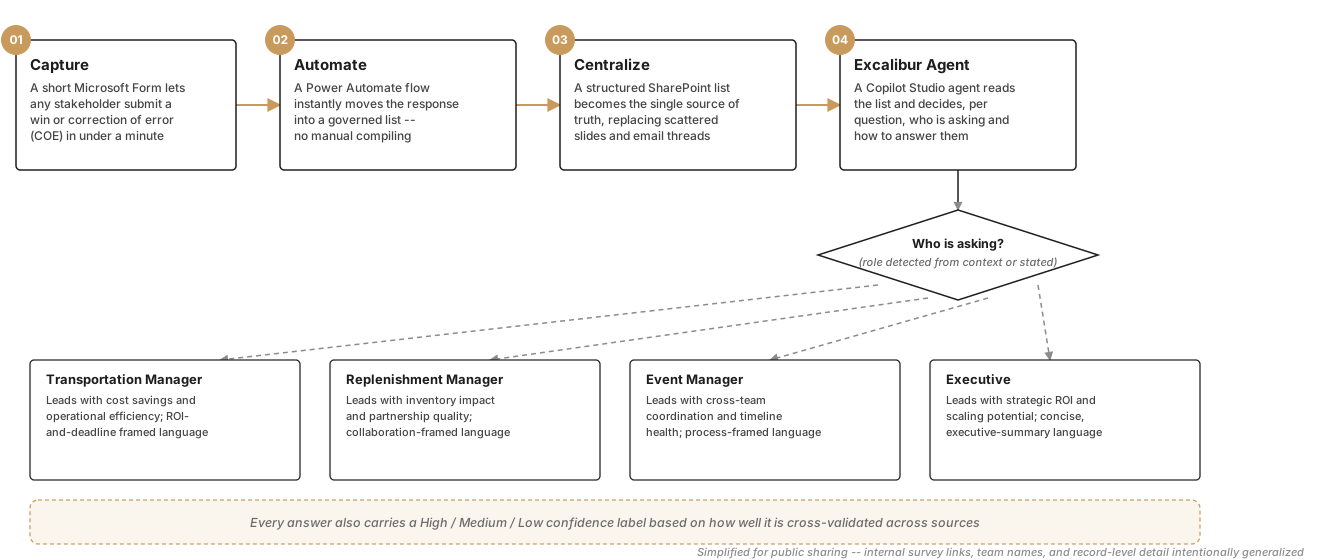
A simplified view of the intake-automation pipeline and persona-adaptive decision tree behind Excalibur. Exact survey links, team names, and record-level detail are intentionally generalized for this public one-pager.
How It Was Designed, Behind the Scenes
The starting point was not a chatbot -- it was a stakeholder map. Before a single agent instruction was written, the real users of this knowledge base were interviewed and documented as full personas: Transportation Managers, Replenishment Managers, Event Managers, and Executives, each with distinct goals, pain points, and vocabulary. That research became a decision tree: detect who is asking (or the shape of what they're asking), route to that role's information priorities, and answer in that role's language, rather than returning one generic summary to everyone. A second, parallel decision tree governed submission: instead of one long freeform form, a short branching sequence -- which of three event types does this fall under? -- routed each submitter straight to the matching intake form. Every answer the agent gives also carries a confidence label, because a number that's been validated across two sources is not the same as one that's been estimated from a single survey response.
Technology Behind the Tool
- Microsoft Copilot Studio (agent instruction and conversation design)
- Power Automate (event-triggered workflow orchestration)
- SharePoint list (governed, structured data layer)
- Microsoft Forms (branching, guided intake)
- Persona-adaptive decision-tree logic (rule-based routing by stakeholder type)
- Confidence-scored, multi-source validation logic
- Fiscal-calendar-aware temporal query logic
Capabilities Demonstrated
- Stakeholder persona research
- Decision-tree / conversation design
- Cross-functional facilitation
- Workflow automation
- AI product design
- Business case development
- Enablement & rollout planning